

In fermentation industries such as food brewing, biological feed, and biomedicine, many companies still rely on manual batching, which not only suffers from low efficiency and significant errors but also faces challenges in environmental protection and traceability. Addressing the material characteristics of the fermentation industry, Sihyde Automation has meticulously crafted an automatic batching production line tailored to actual production needs.
I. Core Comparison: Manual Batching vs. Automatic Batching
1. Batching Accuracy: High Error Fluctuation vs. High-Precision Measurement
Manual batching relies on manual weighing and feeding, leading to significant error fluctuations and easily causing imbalances in fermentation ratios, which affects final product quality. The Sihyde automatic batching line for the fermentation industry is equipped with high-precision weighing sensors, achieving accuracy of ±0.5% for bulk powders and up to ±10g for micro-ingredients, stabilizing fermentation quality from the source and reducing raw material waste.
2. Production Environment: Severe Dust Pollution vs. Fully Sealed, Dust-Free
Manual bag opening and open feeding cause severe dust pollution, deteriorating the workshop environment and easily leading to cross-contamination of materials, making it difficult to meet industry cleanliness requirements. This production line utilizes food-grade 304/316 stainless steel for material contact surfaces, ensuring easy cleaning without residue. It incorporates negative-pressure closed conveying and dedicated dust extraction systems, eliminating direct manual contact with materials for a clean and controlled process.
3. Palletizing and Warehouse Storage: Inefficient and Labor-Intensive vs. Efficient and Labor-Saving
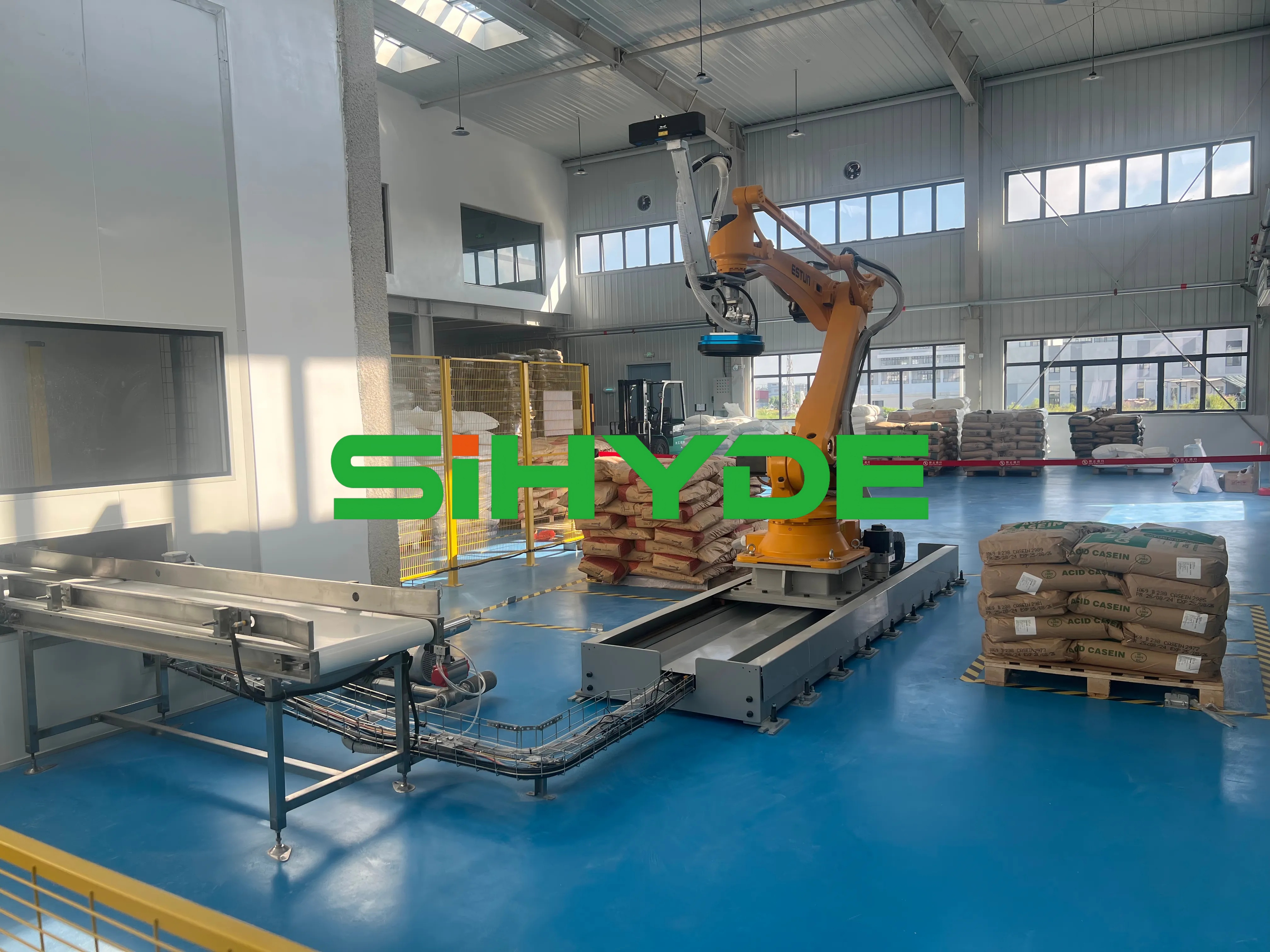
Manual palletizing is time-consuming, requires multiple operators, and limits production capacity. Sihyde Automation employs an intelligent robotic sorting and storage system that adapts to packaging needs, achieving automated and organized handling of finished products. Each module can operate independently or collaboratively, reducing labor costs, improving efficiency, and adapting to large-scale production.
4. Compliance and Traceability: Prone to Record Errors vs. Intelligent Traceability
Manual recording is prone to errors and difficult to trace. The Sihyde automatic batching line for the fermentation industry is equipped with a PLC intelligent control system, supporting recipe storage and making all process data queryable and traceable, thereby assisting enterprises in production management.
II. Customizable: Adapting to Diverse Materials and Application Scenarios in the Fermentation Industry
The Sihyde automatic batching line for the fermentation industry features a modular, split design. It can be exclusively customized based on different fermentation applications such as food brewing, biological feed, and biomedicine, as well as enterprise-specific material characteristics, production capacity, and plant layout.
III. Conclusion
Manual batching can no longer meet the current demands for large-scale, standardized, and compliant production. The Sihyde automatic batching line for the fermentation industry, with its four core advantages of high-precision measurement, fully enclosed dust-free operation, intelligent automation, and non-standard customization, stabilizes fermentation ratios from the source, improves the production environment, reduces labor and raw material costs, and achieves full-process data traceability. It comprehensively solves the challenges of efficiency, quality, environmental protection, and traceability in the batching process for fermentation enterprises, helping them embark on a new journey towards automated, intelligent, and green fermentation production.
